Submerged Reef Constraints
Inchcape reef presents severe topographical challenges. The sandstone ledge submerges entirely under four to five metres of water during high tide. Construction windows limit operations to low water springs, averaging two hours of exposure per tide. Robert Stevenson's design necessitated a temporary timber beacon adjacent to the foundation site to house workers and equipment during tidal inundation.
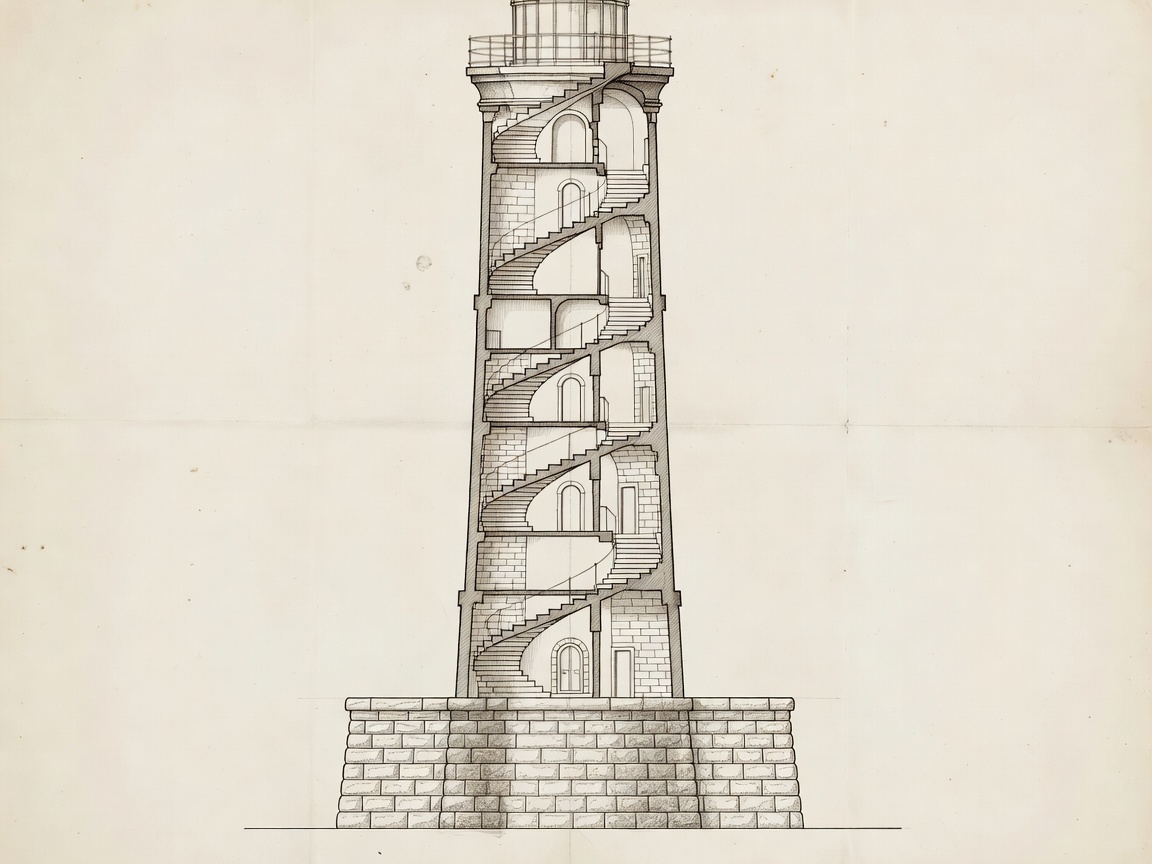
Foundation preparation required levelling the uneven sandstone. Pickaxes and gunpowder were utilised to excavate a flat circular footprint. The base diameter measures 12.8 metres. The first course of masonry sinks entirely into this excavated trench, transferring lateral wave forces directly into the surrounding bedrock rather than relying solely on masonry joints.
Cast iron railway tracks bolted directly to the reef facilitated the movement of stone blocks from the landing point to the foundation trench.
Masonry Structure
Solid construction dominates the lower section. Aberdeenshire granite forms the exterior casing, chosen for abrasion resistance against suspended sand and shingle. The interior core utilises softer Dundee sandstone. Masonry rises solid for the first 14.3 metres above the foundation bed. Above this solid section, the internal voids commence, housing storerooms, water tanks, and crew quarters.
Dovetail joints secure every block. The system mimics Smeaton's Eddystone precedent but extends the complexity. Vertical joggles and oak trenails pin the courses together while mortar cures. Measurements confirm the tower tapers from 12.8 metres at the base to 3.9 metres beneath the lantern gallery. The centre of gravity remains extremely low, enhancing stability against North Sea storm surges.
Northern Lighthouse Board Jurisdiction
The Northern Lighthouse Board exercises statutory authority over Scottish waters and the Isle of Man. Operations differ from Trinity House due to distinct geographical constraints and historical development. The NLB operates from headquarters in Edinburgh, maintaining a dedicated fleet of tender vessels for buoyage and lighthouse resupply.
Administrative processes during construction relied heavily on the Bell Rock Signal Tower in Arbroath. Before telecommunications, visual signalling using flags and semaphore connected the reef workers with the mainland supply base. The Arbroath shore station housed the families of the keepers and served as the logistical hub for transferring provisions and relief crews via cutter.
Optics and Characteristics
Stevenson introduced alternating red and white flashes. This distinct character differentiated Bell Rock from coal fires and other fixed lights on the coast. The original optic employed parabolic reflectors and Argand lamps. Rotation was achieved via a clockwork mechanism driven by a descending weight suspended within the tower's central shaft.
Current illumination utilises a solid-state LED apparatus. The focal plane sits 28 metres above mean high water springs. Light characteristic flashes white once every three seconds. Range extends 18 nautical miles. Automation in 1988 replaced the resident keepers. Telemetry now relays operational status directly to NLB headquarters. The structure remains unmodified since completion, validating the original foundation engineering under continuous extreme load conditions.