Primary Structural Analysis
Reef morphology dictates foundation constraints. Eddystone consists of Precambrian gneiss, projecting marginally above mean low water springs. Initial timber structures by Winstanley and composite designs by Rudyard failed under wind shear and fire respectively. John Smeaton's 1759 tower introduced fundamental masonry principles. Observations indicate Smeaton modelled the profile on an English oak trunk, providing a broad base curving inwards to deflect wave energy upwards rather than absorbing direct lateral impact.
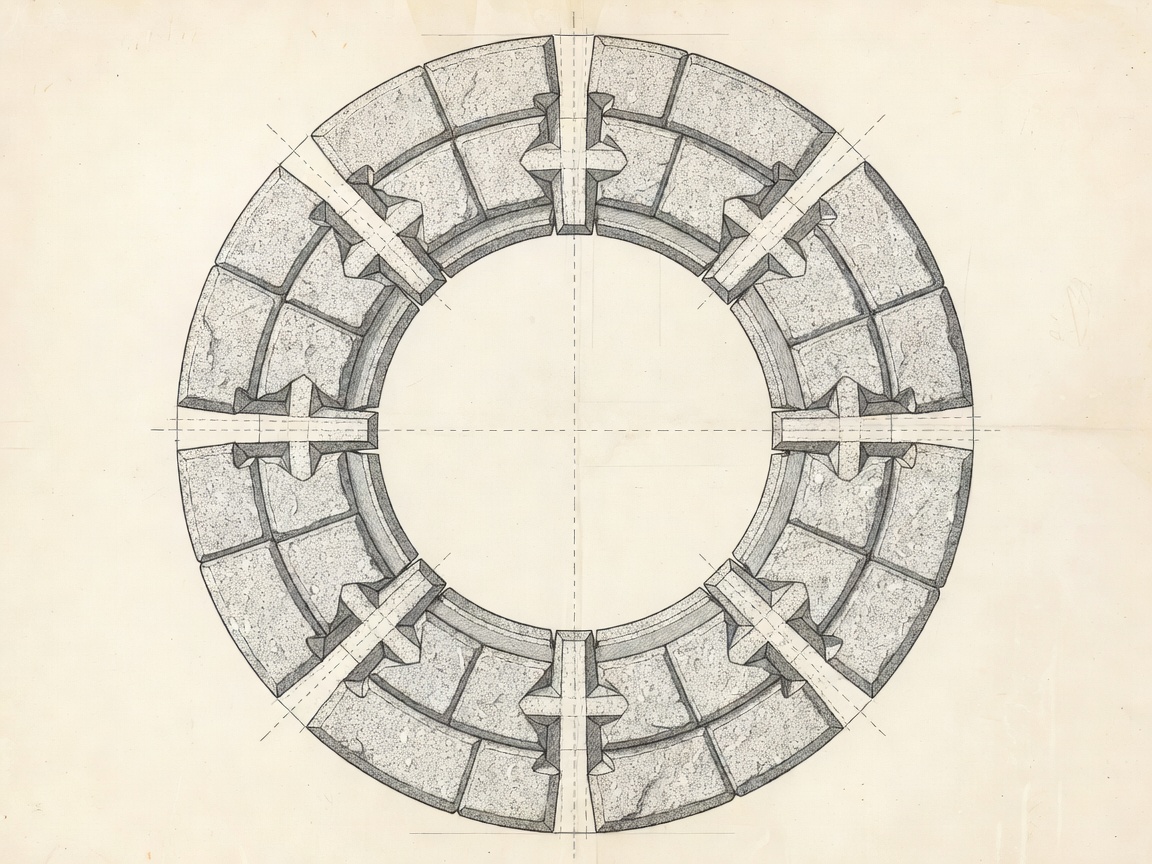
Foundation blocks interlock. Smeaton introduced dovetail joints cut into Cornish granite. Portland cement acts as a sealant, not the primary bonding agent. Structural integrity relies entirely on the interlocking geometry of the stones and gravity. The base stones are trenched directly into the reef, stepped to accommodate the uneven seabed gradient. Horizontal marble dowels secure the courses vertically, preventing lateral slippage under extreme hydrodynamic loads.
Hydraulic lime mortar utilised for underwater setting. Smeaton pioneered the calcination of limestone containing clay to achieve a rapid set in saline environments.
The Douglass Cylinder
Reef erosion undermined Smeaton's foundation. Trinity House engineer James Douglass designed the replacement in 1882. Measurements indicate the current tower rests on a solid cylindrical base rather than a curved profile. Base diameter measures 13.4 metres. Solid masonry rises 13 metres above the rock before the internal cavity begins. The cylindrical plinth shatters incoming waves before they strike the main tapered shaft, a departure from Smeaton's uninterrupted curve.
Granite blocks in the Douglass tower are dovetailed on all faces: top, bottom, and sides. No stone can be extracted without removing those above it. The total mass exerts sufficient downward force to counteract wave buoyancy. Structural taper reduces wall thickness from 2.6 metres at the solid section to 0.6 metres at the lantern gallery.
Optics and Light Characteristics
Lantern room glazed with triangular panes. Diagonal astragals cross the focal plane. Vertical glazing bars create blind spots; diagonal framing minimises this obstruction to the revolving beam. Focal plane situated 41 metres above mean high water.
Current light characteristic flashes white twice every 10 seconds. Range extends 22 nautical miles. Original light source utilised multi-wick oil burners, transitioning to incandescent vaporised oil, then electric filament lamps. The contemporary optic features a fixed LED array. Power is supplied via internal battery banks, charged continuously by solar photovoltaic panels mounted on the gallery rail.
Administrative Jurisdiction
Trinity House retains exclusive operational control. The Corporation of Trinity House acts as the General Lighthouse Authority for England, Wales, the Channel Islands, and Gibraltar. Statutory funding derives from light dues levied on commercial vessels calling at UK ports. Regular maintenance schedules strictly enforced.
Automation completed in 1982. Telemetry data transmits continuously to the Trinity House operational headquarters in Harwich. Variables monitored include battery voltage, solar array output, optic rotation speed, and ambient temperature. A helipad constructed above the lantern gallery facilitates access during rough sea states. Local attendants perform quarterly physical inspections, replacing consumable components and testing emergency backup systems.
Smeaton's upper section dismantled and rebuilt on Plymouth Hoe. Base remains on the reef. Separation illustrates the durability of the dovetail bonding; the rock fractured before the masonry joints yielded. Continuous observation confirms the Douglass tower remains structurally sound, requiring only superficial pointing of external mortar joints.