Foundation and Gneiss Geology
Skerryvore reef lies 12 miles southwest of Tiree. The rock comprises Lewisian gneiss, an extremely hard metamorphic basement rock. Surface topology is deeply fissured and highly irregular. Alan Stevenson's engineering approach required blasting and excavating the gneiss to form a level foundation pit measuring 12.8 metres in diameter. The hardness of the rock severely retarded excavation speed, requiring constant resharpening of iron tools.
Structural volume significantly exceeds Bell Rock. Skerryvore stands 48 metres high. Solid masonry rises for the first 8 metres. Granite blocks were quarried from Mull and Hyskeir. Tonnage calculations indicate the tower contains over 4,300 tons of granite. The hyperbolic curve of the tower face generates a mass distribution that perfectly counterbalances calculated wave impact forces.
Marine dynamometers recorded Atlantic wave impacts during construction. Measurements indicated pressures of 3,000 kilograms per square metre during severe winter gales.
Hyper-Radial Lens Integration
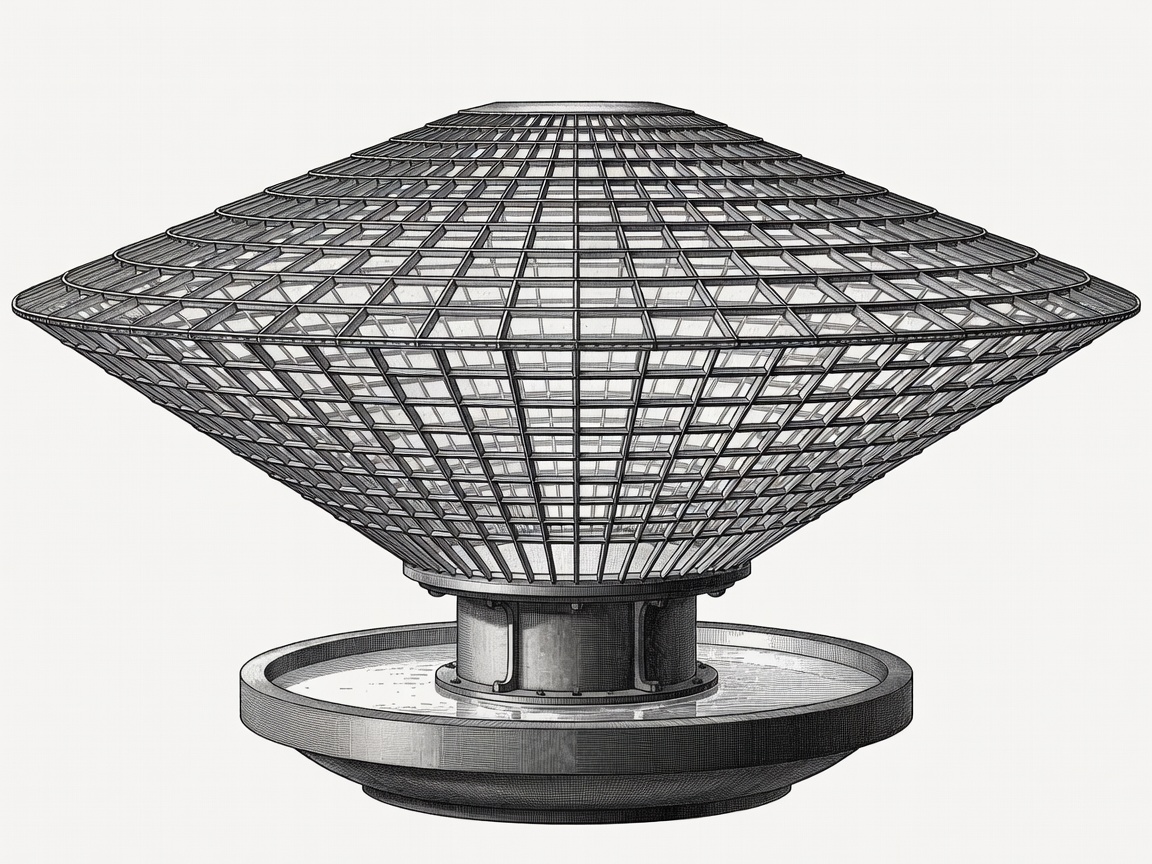
Optic size determines light gathering efficiency. Skerryvore eventually housed a first-order dioptric apparatus. The internal dimensions of the lantern room required structural reinforcement to support the mass of the glass and brass framework. The lens assembly floats in a cast-iron annular trough filled with mercury. This reduces mechanical friction to near zero, allowing a relatively small clockwork weight mechanism to rotate tons of optical equipment at a precise and constant speed.
Stevenson designed the lantern glazing with helical astragals. Unlike vertical or diagonal framing, the helical pattern ensures that no point on the horizon suffers a continuous shadow as the light rotates. Focal plane sits at 46 metres above mean high water. Current characteristic flashes white once every 10 seconds.
Construction Logistics
Hynish on Tiree served as the mainland work yard. The quarrying, dressing, and trial assembly of the granite courses occurred at the shore station before transport to the reef. Each stone was numbered, verified for dimensional accuracy, and loaded onto specially constructed tenders. The transit between Hynish and Skerryvore traverses exposed Atlantic swell, restricting material transfer to summer months.
A temporary barrack structure on the reef housed the workforce. Supported on wrought iron stanchions drilled into the gneiss, the barrack suspended the living quarters above normal wave height. Total construction spanned six seasons, dictated entirely by weather limitations.
Operational Status
The Northern Lighthouse Board maintains Skerryvore as a fully automated station. A severe fire in 1954 gutted the interior, destroying the original internal timber fittings and necessitating a complete internal reconstruction. Structural masonry remained intact, proving the thermal mass and stability of the granite shell.
Current power systems rely on battery arrays charged by solar panels mounted on the exterior gallery. The mercury float mechanism has been removed and replaced with a static LED beacon and electronic flasher unit. Telemetry relays structural health and power metrics to NLB headquarters. Helicopter operations manage all maintenance access, utilising a pad constructed above the lantern roof.